Safety Management Software Is Facing an AI Reckoning — Here Is What Comes Next
The consolidation wave is coming, vendor lock-in is a trap, and in-house AI capability will reshape every safety team
In a previous piece we mapped the evolution of safety management software from digital filing cabinets to the edge of AI-driven automation. That future has arrived sooner than most vendors planned for — and the industry is not ready.
An Industry Facing Inevitable Consolidation
The safety software industry is facing a period of extreme consolidation that almost none will escape — it is inevitable, and it is not going to be pretty. When that inevitability strikes, the process of consolidation will be swift and the levels total. The more innovative teams that adapt faster will survive; others will go bust.
Interestingly, it is not deep pockets that will save those that survive. This cannot be thwarted by acquiring smaller competitors, since this is not a race to add more human intelligence — quite the opposite. It is a race to harness artificial intelligence, and only specialist AI-focused teams will be eligible for acquisition.
Vendor Lock-In: Read the Small Print
We now believe that many current vendors of safety software are aware of this impending extreme consolidation of the industry. The more savvy ones are likely currently locking their clients into new multi-year contracts with expensive break clauses, alongside promises of AI revolutions that are too good to miss.
For the buyers of safety management software, our advice is simple: this is not the time to sign up to multi-year deals. The capabilities around the corner will make such contracts superfluous before the ink has fully dried.
This is not the time to sign up to multi-year deals — the capabilities around the corner will make such contracts superfluous before the ink has fully dried.
The Rise of In-House Capability
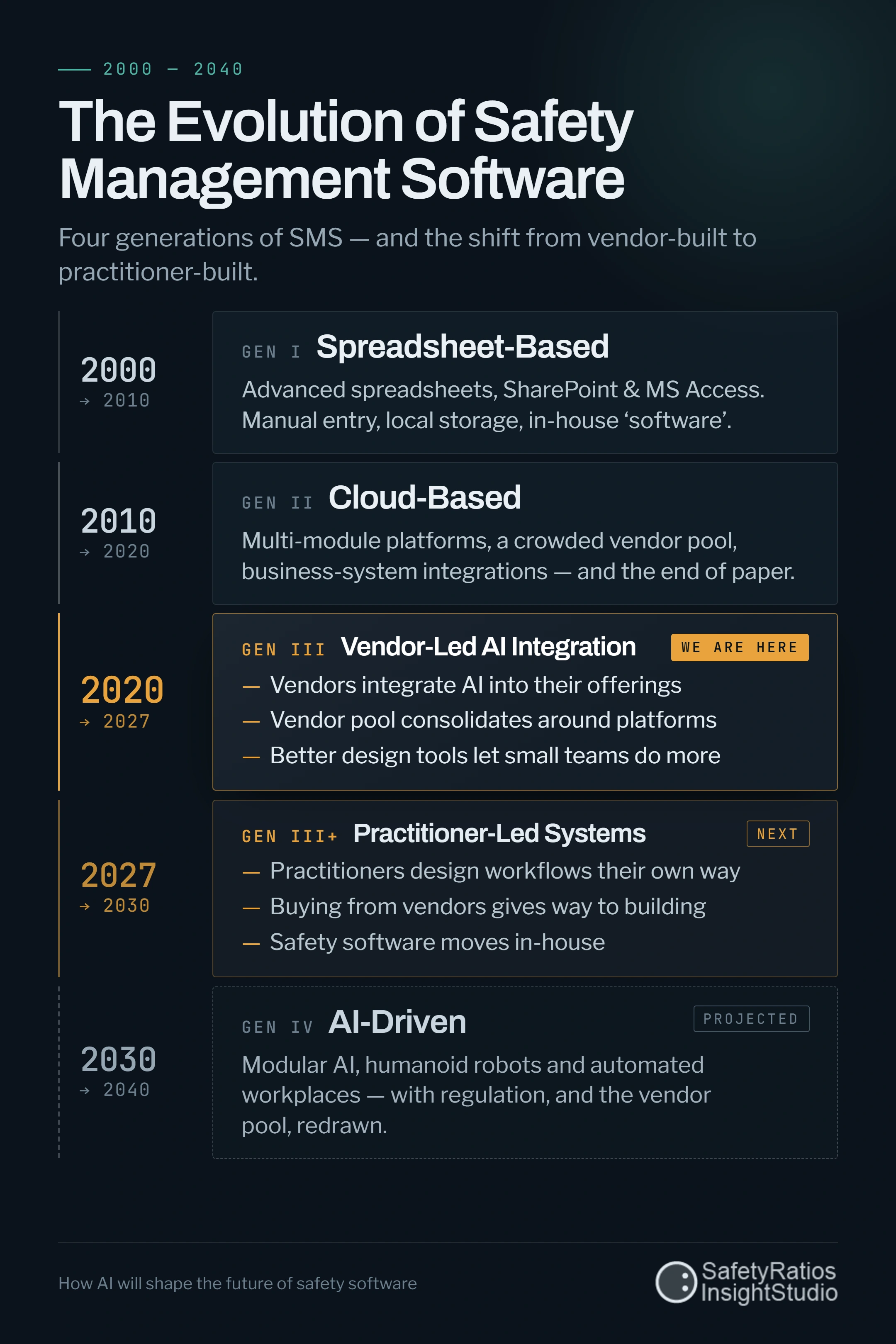
Having seen first-hand what a dedicated safety practitioner alongside a supervised AI model can produce in the form of safetyratios.com, we believe that by 2030, most organisations will be able to aggregate, analyse and curate their safety data using very small in-house teams.
If a solo developer with self-taught knowledge of software development can be supported with today's Large Language Models (LLMs) to produce the extensive body of work on this site, a well-funded in-house team will be more than capable of managing all data curation in-house within every organisation that decides to do so.
In fact, every professional will be capable of magnified productivity with personalised AI assistants that turn any imagination into a working user interface. As we experienced during our own build, the in-house safety practitioner will be able to construct data collection, analysis and dissemination systems in exactly the way they envision them.
Engineers, cost managers, HR professionals and even executives will be able to design every tool they have ever dreamed of for optimising their work.
The Connected Organisation
Picture a safety manager with their ultimate workflow set-up meeting a design manager with theirs, and a procurement manager with theirs — each operating with a personalised AI layer of a broader organisational-level AI that connects them all. With everyone's work optimised through a connected AI layer in the background, harmonising those optimisations across the organisation is just one step further.
Collectively they will do more than the sum of their individual best works. That is the future that beckons, and we predict it will be upon us by the early 2030s.
Organisational-level connected AI alongside personal-level optimised AI will bring a level of efficiency hitherto unseen within organisations — and all operated with the data privacy and security that comes with such internal applications. Today's safety management software will pale in insignificance compared to the capability of such systems.
What This Means for Safety Professionals
For the safety practitioner, as with other professionals, it is time to become familiar with the future of the profession and to think beyond the current limitations of communication. Very soon, you will be able to deliver personalised hazard information to the exact person who needs it, in the singularly most efficient way it can reach them.
The days of sending pages of risk assessment to a team ahead of work in a confined space are ending. Think of any other way you can communicate that information — and know that the tools to make any number of such innovative approaches work are just around the corner.
Training standards and methods that apply today will be rendered redundant as focus moves towards judgement and away from raw information or the ability to collect and synthesise it.
Regulations, standards, policies and procedures will likely be built directly into processes in a manner that makes knowledge of individual standards less important, while knowledge of why people deviate from those standards becomes more important — humans will continue to be better at understanding human motivations for the foreseeable future.
And crucially, the current crop of safety management software will be obsolete. A new generation of tools built and optimised to fit the specific needs of teams will dominate. They will be built by the teams themselves. They will be highly interoperable across departments, organisations and jurisdictions.
They will be highly adaptable to fit changing work conditions without waiting for a vendor team to push updates. And they will require a new range of skills from the professionals who intend to get the best out of them.