10 Leadership Barriers to Workplace Safety—And How to Fix Them
Closing the Leadership Gap for Stronger Safety Commitment
Leadership engagement is widely recognised as one of the most critical drivers of workplace safety. Regulatory guidance and standards such as ISO 45001 emphasise that senior management must demonstrate leadership and commitment for safety management systems to succeed. Yet, despite these expectations, many organisations struggle to secure genuine management buy-in.
In practice, safety is often positioned as a declared priority but not always treated as one in operational decision-making. Financial performance, productivity targets, and competitive pressures frequently take precedence, creating a gap between leadership messaging and everyday practice.
Barrier 1: Cost-Focused Business Norms
Many organisations operate within cultures that prioritise financial performance above all else. When difficult decisions arise, cost considerations may overshadow safety investments, even if safety is publicly described as a core value.
Barrier 2: Limited Understanding of Safety Value
Senior leaders may underestimate the broader value of safety management beyond accident prevention. Without clear evidence of operational or financial benefits, safety initiatives may be viewed as compliance obligations rather than strategic investments.
Barrier 3: Conflating Safety with Accident Prevention
Safety management extends far beyond preventing accidents. Effective systems address communication, risk awareness, operational design, and organisational learning. When safety is reduced to accident statistics alone, deeper systemic issues may be overlooked.
Barrier 4: Confusion Around Responsibility
Ambiguity around responsibility, authority, and accountability often weakens safety leadership. While safety responsibilities can be delegated, ultimate accountability remains with top management under international safety standards.
Barrier 5: Poor Integration of Safety Roles
When safety roles are treated as separate from operational responsibilities, safety becomes an add-on rather than a core function. Integrating safety tasks directly into daily operations helps ensure consistent implementation.
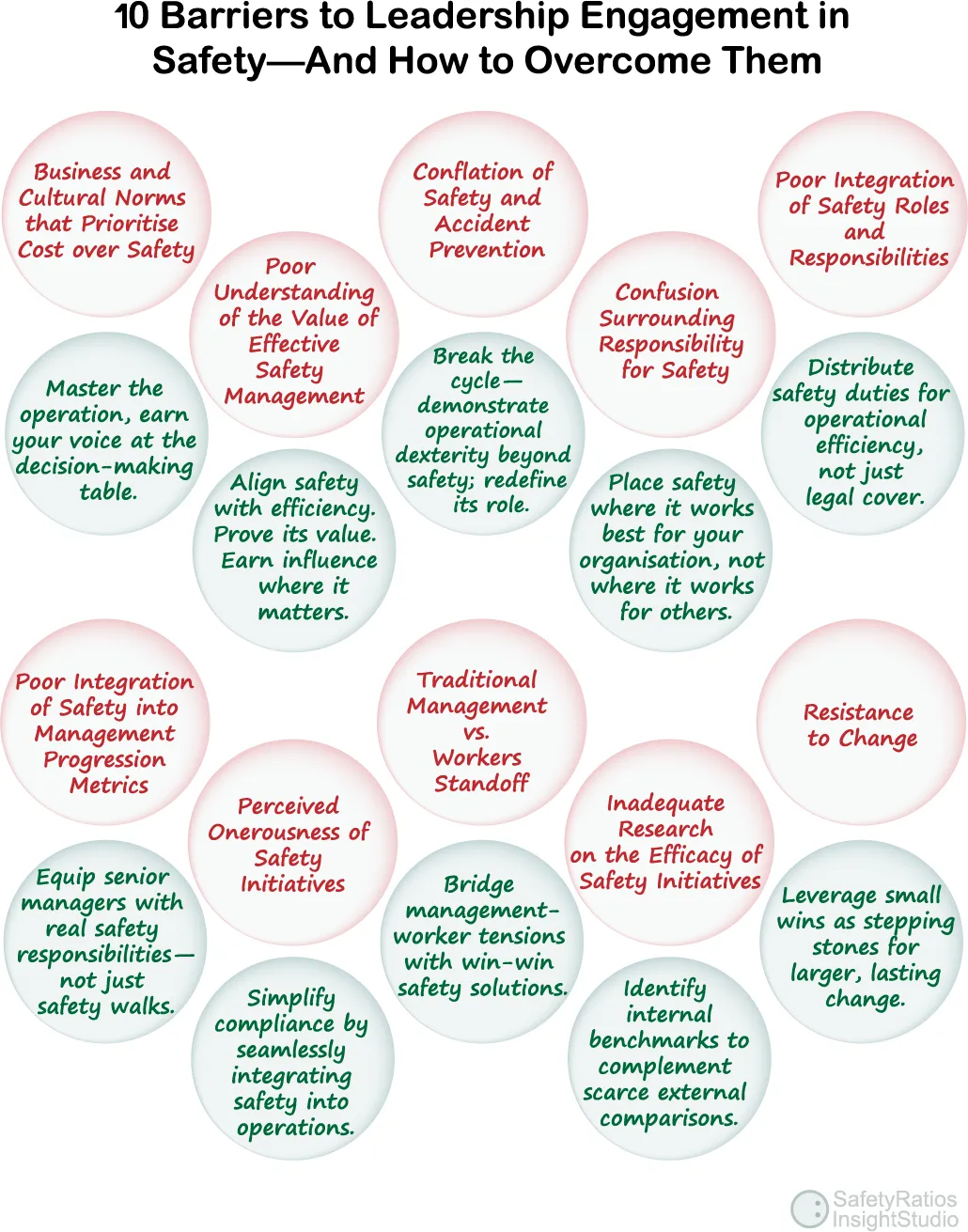
Barrier 6: Weak Links to Management Performance Metrics
Leadership behaviour often follows the metrics used to evaluate performance. If safety achievements are not meaningfully reflected in promotion or performance systems, leadership engagement may remain superficial.
Barrier 7: Perceived Burden of Safety Initiatives
Safety initiatives may be perceived as bureaucratic or time-consuming when they are not integrated into operational workflows. Embedding safety processes into routine activities reduces this perception.
Barrier 8: Management–Worker Tensions
Historical tensions between management and workers can influence safety engagement. When safety becomes part of broader organisational conflict, cooperation and transparency may decline.
Barrier 9: Limited Evidence on Safety Effectiveness
Compared with financial performance, safety effectiveness is often difficult to benchmark across organisations. The lack of standardised safety metrics can make it harder for leaders to evaluate the value of safety initiatives.
Barrier 10: Resistance to Change
Organisational change often meets resistance, especially when new safety practices are perceived as disruptive to established workflows. Overcoming this barrier requires gradual integration and visible leadership support.
Ultimately, strengthening safety leadership requires aligning organisational incentives, operational systems, and leadership behaviour. When leaders actively demonstrate commitment and integrate safety into strategic decision-making, organisations can move beyond symbolic support and achieve meaningful safety improvements.
Frequently Asked Questions
Why is leadership engagement important for workplace safety?
Leadership engagement sets priorities, allocates resources, and influences organisational culture. When leaders demonstrate commitment to safety, employees are more likely to follow safe practices.
What is management buy-in in safety management?
Management buy-in refers to genuine support and involvement from senior leaders in safety initiatives, including providing resources, setting expectations, and actively participating in safety activities.
Why do organisations struggle with safety leadership?
Common challenges include financial pressures, competing operational priorities, unclear safety responsibilities, and limited understanding of the broader value of safety management.
How can organisations improve leadership engagement in safety?
Organisations can improve engagement by integrating safety into operational decision-making, linking safety performance to leadership metrics, and demonstrating the operational benefits of strong safety systems.
What role does ISO 45001 play in safety leadership?
ISO 45001 emphasises leadership and worker participation as essential elements of effective safety management systems, requiring top management to demonstrate commitment and accountability.